
March Newsletter: A Note from a Member of our Board
Dear Friends,
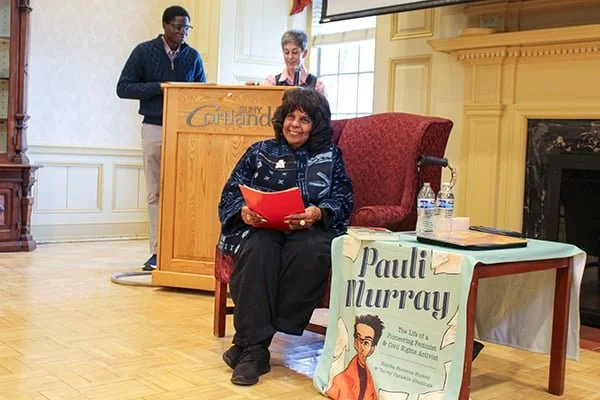
In 2023, Rosita Stevens-Holsey received the Woman of Vision Award from the organization her aunt co-founded, the National Organization for Women (NOW) for her ongoing work to preserve and promote the legacy of Murray. In 2024, she received the Distinguished Alumni Award from SUNY-Cortland. The award recognized her multifaceted career in education and management as well as being an author, activist and sharing the legacy of her aunt.
In a time when every citizen can champion women’s history, a commitment that invests in our educational and historical future, I am reminded that the contributions of women are too often obscured, underrecognized, or completely erased. Women remain underrepresented in textbooks, monuments, awards, archives, and other markers of public memory. Recognizing the contributions of women from all racial and ethnic backgrounds is essential to telling the full story of our country.
Women’s History Month, a movement that was spearheaded nearly 40 years ago, reminds us that celebrating women’s history is essential for building an accurate narrative and an equitable future. Knowledge of women’s strengths and contributions builds respect, nourishes self-esteem for young girls, and expands their sense of what is possible. Women’s history must be known, accurate, and inclusive.
This charge feels especially urgent now.
In an era when contributions of women, including my aunt, Rev. Dr. Pauli Murray, are often overlooked or erased, legacy requires action. Aunt Pauli’s life challenges that erasure. She moved fluidly across law, theology, literature, and activism, illuminating the connections between justice, identity, and moral imagination. She did not simply participate in civil rights, women’s rights, and LGBTQ+ movements, she helped formulate the legal arguments that dismantled both “Jim Crow” and “Jane Crow,” (a term she coined naming the double discrimination she endured as a Black woman).
Murray was often omitted from history because she was Black, gender-nonconforming, and lived in ways that defied the rigid expectations of her time. Attempts to remove or minimize her biography are not merely symbolic; they represent broader efforts to narrow our collective understanding of who shapes democracy. The devaluation of women like Pauli Murray is a historical loss and a diminishment of the very foundations upon which current rights stand.
Women’s History Month, therefore, is not only celebratory. It is corrective and protective.
I think we should proactively preserve and document women’s lives, through digital and physical archives, oral histories, personal artifacts, through partnerships with institutions like the Schlesinger Library and through ensuring that women’s scholarship and stories remain visible in major public platforms and collections. Let’s look beyond traditional textbooks and invest in the organizations and specialized archives that safeguard the complexity of women’s experiences.
At the Pauli Murray Center for History and Social Justice, we believe that when women’s history is made visible, we challenge bias, empower individuals, foster equity, and draw attention to underrepresented contributions. By uplifting Aunt Pauli’s legacy through education and public engagement, we aim to inspire understanding, progress, and meaningful discourse and action.
Aunt Pauli was often described as prophetic; she was impatient in the face of injustice and insistent with keeping the pressure on. Her life reminds us that courage, imagination, and persistence can reshape society.
This Women’s History Month, let’s do more than commemorate: document, teach, amplify! May we ensure that pioneers like Aunt Pauli are recognized not as footnotes, but as central architects of human rights.
With gratitude and determination,
Rosita Stevens-Holsey
Board Member and Niece of Pauli Murray