
December Newsletter Reflection: A Note from our Executive Director

Dear friends,
2024 has been a year of abundance for the Pauli Murray Center. We began the year commemorating the release of the Pauli Murray Quarter. The milestones didn’t stop there: we completed the decade-long rehabilitation of Rev. Dr. Murray’s childhood home, celebrated the Center’s grand opening, secured funding to purchase Pauli Murray’s ancestral land, and so much more. Our growth most certainly aligns with the work that is ahead. We are well-positioned, now more than ever, to accept Murray’s charge to march endlessly towards justice. We’ll fulfill this duty by offering programs that connect Murray’s work and legacy to today’s most pressing justice issues in the U.S. South; by integrating social justice- and equity-centered teaching pedagogies in NC classrooms, shaping the next generation of “firebrands”; and by continuing to cultivate Murray’s childhood home and ancestral land as places where justice-oriented work can be incubated and nurtured. I hope you’ll continue to walk alongside us as this work takes shape.
Onward,
Angela M. Mason
Executive Director
Pauli Murray Center for History and Social Justice
November Newsletter Reflection: A Note from our Executive Director

Dear friends,
I'm writing this note to you on Nov. 4th, on the eve of what will be yet another consequential Election Day. When you read this, we will likely have begun navigating the headwinds of the election results and ultimate election outcome. Rev. Dr. Pauli Murray envisioned, for her lifetime, an America that we continue to aspire towards. A nation where each person lives a free, dignified life, without concern for their rights or shrinking any part of their identity. As a 30-something, Pauli Murray offered strategies for how they sought to advocate for this America: "...by persuasion, by spiritual resistance, by the power of [their] pen, and by inviting violence upon [their] own body...by positive and embracing methods." As you consider the strategies you've employed to help us achieve the America we are still striving towards, remember that Pauli Murray reminds us that freedom is our inheritance. As we navigate this election's outcome, we must also take up Murray's charge that comes as a result of that inheritance: we are heirs to the "...tradition of an endless march toward freedom..." Though they may feel so, these times are not unprecedented. Rev. Dr. Murray lived in times where democracy hung in the balance. So did her parents, grandparents, and great grandparents. Steward your inheritance with care. Our work does not end after November 5th.
Onward,
Angela M. Mason
Executive Director
Pauli Murray Center for History and Social Justice
Rev. Dr. Pauli Murray on 11th American Women’s Quarter
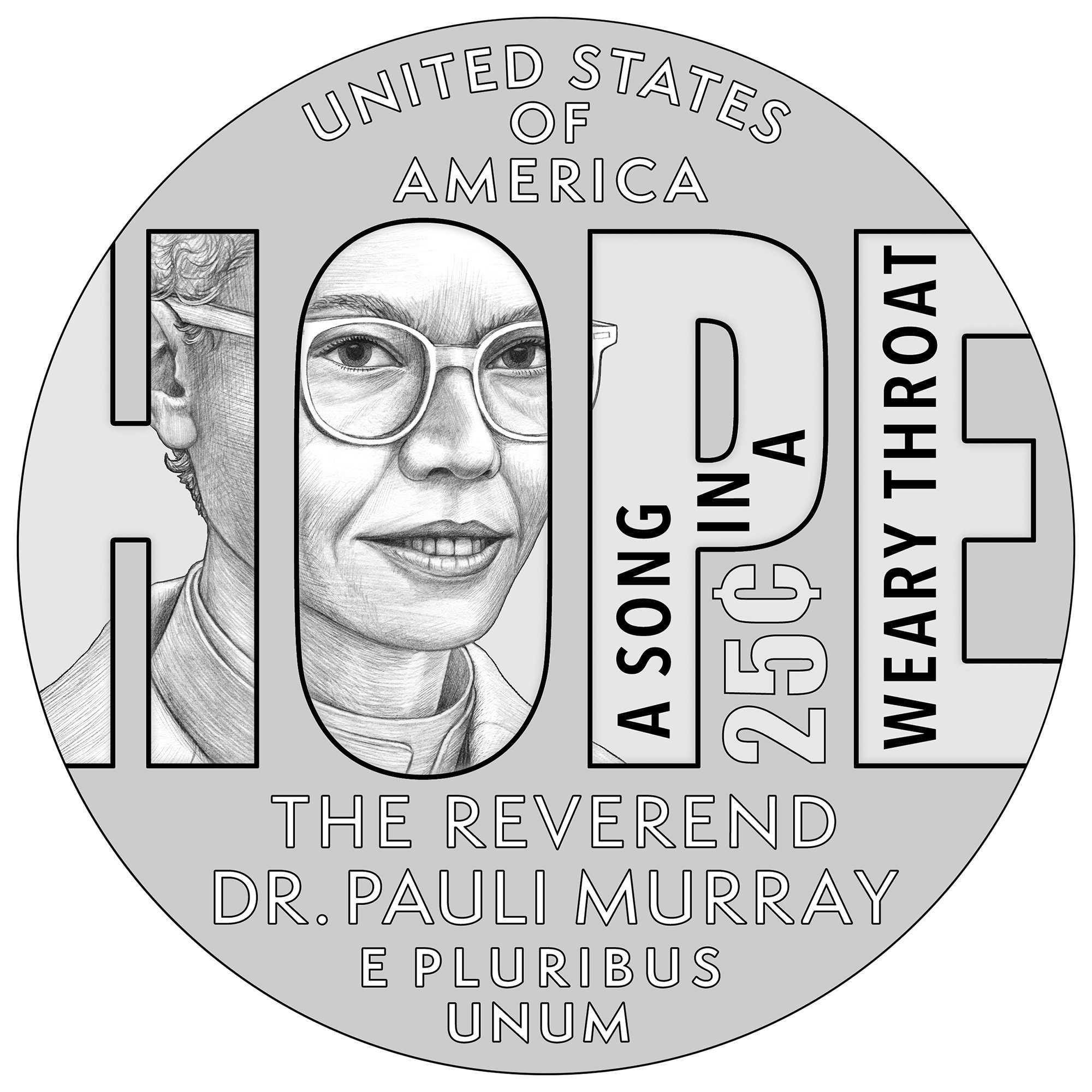
Rev. Dr. Pauli Murray on 11th American Women’s Quarter
DURHAM, N.C.– The Pauli Murray Center for History and Social Justice eagerly awaits the U.S. Mint’s Rev. Dr. Pauli Murray quarter. To be released in 2024, the 11th quarter in the American Women's Quarter Program will celebrate Rev. Dr. Murray’s life as an activist, writer, lawyer, and Episcopal priest. Rev. Dr. Murray will join other recipients like writer Maya Angelou, astronaut Dr. Sally Ride and First Lady Eleanor Roosevelt. While the face of the quarter will continue to depict George Washington’s likeness, the reverse (tail) depicts Rev. Dr. Murray’s eyeglass-framed face within the shape of the word “HOPE”. The word “HOPE” honors Rev. Dr. Murray’s belief that significant societal reforms were possible when rooted in hope. A line from her poem “Dark Testament,” characterizes hope as “A SONG IN A WEARY THROAT,” an inscription in the design.
This significant recognition of Rev. Dr. Murray’s life and legacy has been championed by advocates and activists around the world, including her niece, and Pauli Murray Center board member, Rosita Stevens-Holsey. “The Rev. Dr. Pauli Murray's quarter design is certainly one of the most unique of all of those in the American Women Quarters Program,” she said. “When I see my aunt's face looking out through the letters of the word "hope", it brings to mind that she never lost hope in a society and world that needed to change to embrace the rights of all humans. Her selection as one of the honorees is validation and a testament to more than 50 years of achievements in social justice, women's rights, civil rights, and human rights.”
As we approach the 2024 quarter release, the Center is excited to celebrate this milestone in company with our supporters and friends in North Carolina. May Rev. Dr. Murray’s work and life keep modeling progress, justice, and community.
About the Pauli Murray Center
The Pauli Murray Center for History and Social Justice engages diverse communities to lift up the life and legacy of activist, legal scholar, feminist, poet, Episcopal priest, and LGBTQ+ community member, the Rev. Dr. Pauli Murray, in order to address enduring inequities and injustice in our nation. The Pauli Murray Center is a National Historic Landmark site anchored by Pauli Murray’s childhood home in Durham, North Carolina. The home stands on its original site, a one-acre plot, in the historically Black working-class West End neighborhood. PMC is quickly becoming a fully operational, visitor-ready site. Over the next few years, we will completely rehabilitate and create an accessible historic home and education center; build on our robust calendar of workshops, both on the ground and virtually; host community dialogues and invitations to action; and lead creative arts programming.
Revolution and Reflection through Mind in Flux: Artist SJ Willis Interview
Charlotte-based artist SJ Willis, and 2023 Firebrand Sophie Yost talk about SJ's work "Mind in Flux", queer identity, and the inspiration behind SJ's art. "Mind in Flux" is a striking mix of revolution and reflection through the lens of Black, queer identity and emotions.
Watch the full interview here or on Vimeo
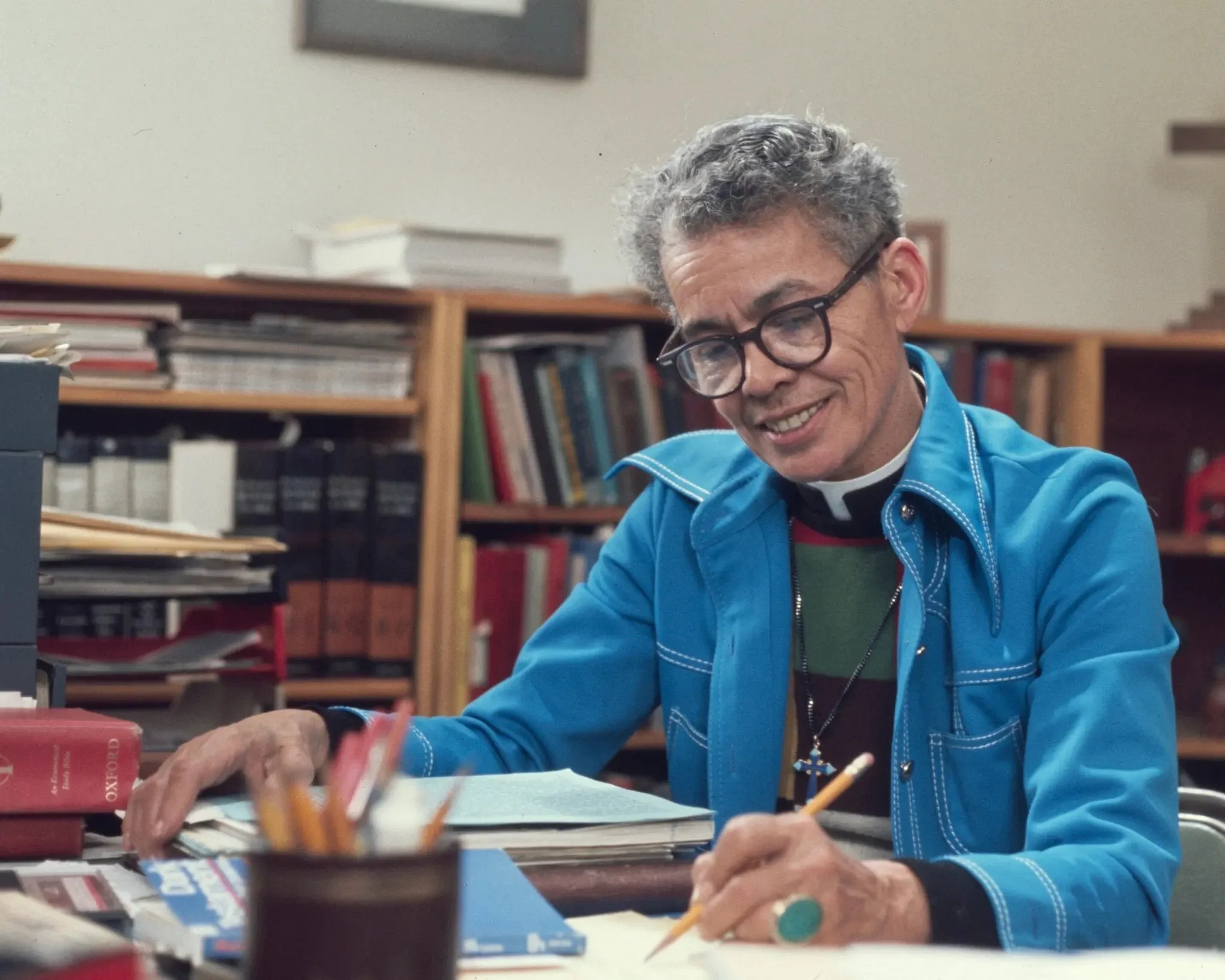
Pauli Murray to Be Featured on U.S. Quarters
The Pauli Murray Center is thrilled to share that Pauli Murray, the pioneering activist, scholar, poet, and priest, will be featured on a series of U.S. quarters beginning in 2024 as part of the U.S. Mint’s American Women Quarters Program. The program, which began in 2022, celebrates figures in U.S. history who have made outstanding contributions to American civil rights, history, art and culture, science, and more. Murray will be honored alongside Patsy Takemoto Mink, Dr. Mary Edwards Walker, Zitkala-Ša, and Celia Cruz. The designs will be released in mid-2023.
This recognition presents an opportunity to explore Pauli’s own writing, and more recent scholarship, about their relationship to gender and womanhood. We do not and can never know Murray’s gender identity – Pauli Murray described themself as a “he/she personality,” requested hormone therapy, and also self-described as a woman. The Pauli Murray Center currently uses she/her and they/them pronouns when discussing Dr. Murray’s life. We encourage those interested to explore the many resources about Pauli Murray, gender, and pronouns, including Dolores Chandler’s Pauli Murray: Black Revolutionary and Simon D. Elin Fisher’s Pauli Murray's Peter Panic: Perspectives from the Margins of Gender and Race in Jim Crow America.
The Pauli Murray Center hopes that this unique honor will encourage those who might come across a Pauli Murray quarter to learn about their vision for a just world – including exploring Murray’s legal impact, activism, scholarly and poetic writing, and her legacy in Durham and beyond.
About the Pauli Murray Center
The Pauli Murray Center for History and Social Justice engages diverse communities to lift up the life and legacy of Black activist, legal scholar, feminist, poet, Episcopal priest, and LGBTQ+ community member, the Rev. Dr. Pauli Murray, in order to address enduring inequities and injustice in our nation.
The Pauli Murray Center is a National Historic Landmark site anchored by Pauli Murray’s childhood home in Durham, North Carolina. The home stands on its original site, a one-acre plot, in the historically Black working class West End neighborhood. We are becoming a fully operational, visitor-ready site. Over the next few years, we will completely rehabilitate and create an accessible historic home and education center; build on our robust calendar of workshops, both on the ground and virtually; host community dialogues and invitations to action; and lead creative arts programming.
Interview with the Rev. Winnie Varghese
Barbara Lau recently interviewed the Rev. Winnie Varghese, who is giving a sermon at the annual Diocesan observance of the Feast of the Rev. Dr. Pauli Murray. To learn more about the service, which will be held on June 22, 2022, visit this page on our website.
This interview was edited for length.

A national leader in the Episcopal Church, the Rev. Winnie Varghese is known for her inspired writing, teaching, and preaching. Before becoming the 23rd rector of St. Luke's, she served as Priest for Ministry and Program Coordination at Trinity Church Wall Street in New York City.
Prior to Trinity, Winnie served as Rector and Priest-in-Charge at St. Mark’s in the Bowery in New York. Winnie was also Chaplain at both Columbia University and University of California Los Angeles. She is a native of Dallas, Texas and is married to Elizabeth Toledo, a public relations executive. They have two grown children.
Winnie serves on the Board of Trustees of Union Theological Seminary, she chaired the General Convention’s Committee on the State of the Church from 2015 to 2018, and she served on the Board of Trustees of the Episcopal Divinity School, 2013-2016. She is also a published author, editor, and podcaster.
Winnie’s parents immigrated to the United States from India, and Winnie spent part of her early childhood years there. She attended Agnes Scott College in Decatur, GA and earned her bachelor’s degree from Southern Methodist University in Dallas. She then attended Union Theological Seminary and graduated with her Master of Divinity degree in 1999. She was ordained to the deaconate in Los Angeles in 1999 and to the priesthood six months later in 2000.
“I think what drew me to Pauli Murray is that she created a reality that was true to her lived experience in her body. She didn’t deny the things that she held true, even when they didn’t align with the movements of the time. I just feel a really deep resonance with that. I feel called to serve the church, a church that didn’t know what to make of me through most of my life.”
Barbara Lau: Recently, someone who knew Pauli Murray shared that everyone who knows Pauli has a “Pauli story.” What’s your Pauli story?
Rev. Winnie Varghese: I have so many stories people have shared about Pauli Murray, so I'll tell you one. When I was the rector of St. Mark's Church-in-the-Bowery, which is in the East Village [in New York City], a man came to visit me who wanted us to bury the ashes of his mother on site. Now the scandal is that it's the East Village in Manhattan so you can imagine there's very limited space to bury anyone. Somehow he had figured out that we're one of the few places that still had a crypt that could open, and you could put ashes in it. Very few people are buried there because there is very limited space.
So he comes to ask me this, and so we're trying to figure out what to do, right? I like him a lot and he says, “My mother has lived in this neighborhood forever. When I came out as a gay man she was really supportive. She was part of the Harlem Renaissance, and knew all of these amazing characters who were part of my growing up.” She sounds wonderful.
He looks at me and says, “Have you heard of Pauli Murray?”
“Yeah I’ve heard of Pauli Murray.”
He says, “My mother was the house mother at one of the women's dorms at Howard. The Dean of the Law School - the man that organized the law school to study what became the critical move of civil rights and shifted the nature of how we understand our constitution, he intentionally recruited people like Thurgood Marshall and others to come together to figure this out.
Pauli Murray applies to Howard and she's admitted. That dean of the Law School goes to this man's mother and, according to him, says, “We've admitted this woman and she would have to live here. She lives a questionable lifestyle, and if you say no, and there's nowhere for her to live then we don't have to admit her and that's fine. You can say no.” So she said, “Yes, why not? I don’t know what the problem is.”
Of course, we buried his mother. It made me wonder how many people, for all of us, no matter how fierce and mighty we are, are also equipping and empowering.
I told that story to a gathering of leaders at St. Mark’s. As I’m telling the story, this older Black woman who has been there forever, said, “Oh, yeah. Pauli Murray was a member of the church. She was the first woman on the vestry. She wrote some really heated letters - I'm sure they're in a file. She was the first woman, and she was so angry with a lot of what we were doing. We were all separatists then, there was a Black and brown caucus. She was so enraged by it that she wasn't very pleasant to be around, and then she quit out of frustration by how horrible the men on this vestry were.” Someone brought me the Pauli Murray file. That's my Pauli Murray story.
BL: Where did you first learn about Pauli Murray?
WV: I've been trying to think about this and I don't know. As long as I can remember, I have had a picture of Pauli Murray on my desk from when I was in seminary.
I think of all the different ways I might have encountered her - I think what happened is I encountered her through her activism and not through the Episcopal Church. Then I saw a picture of her with a collar on and was so moved by it that I just kept it. That was before the Internet was really a thing, so I got Proud Shoes and I got some articles and she was kind of a personal mentor to me in my mind.
I know I didn't learn about her in seminary. I think it was just my own digging around, and then, when I came back to New York, started to understand that I was living in spaces that she had been in, and then began to learn from people who knew her personally.
BL: How is the Rev. Dr. Pauli Murray an inspiration for your ministry?
WV: I just learned, a couple of years ago, that we share an ordination date. She was ordained on January 8th. I had no idea.
As a young adult, I assumed that I would have a life as an activist and would be fairly on the margins of things. My sense of what is right tends to be a little bit on the radical side. She, like Dorothy Day and others, I find her story so inspiring.
What was inspiring was I didn't understand the faith component of her life until a little bit later in my own life. I was really moved by her vision for what is right that is so internally driven in a world where segregation was the way of the land. Fighting segregation was about defining oneself as purely Black or white. Feminism was white. Poverty and illness were defining. She wasn't defined by any of those categories for me was so true to my life.
If I wanted to exist in this country, people like me didn't exist. In my young mind, I could disappear. When I would ask professors about it, to try to understand where I fit as an Indian woman, as a queer woman, and at that time not necessarily looking like the gender people expected me to look like - imagining a future with a vocation in the church? Those things literally didn't exist.
I think what drew me to Pauli Murray is that she created a reality that was true to her lived experience in her body. She didn't deny the things that she held true, even when they didn't align with the movements of the time. I just feel a really deep resonance with that. I feel called to serve the church, a church that didn't know what to make of me through most of my life.
Pauli Murray walks through categories that we still struggle with. To me, so inspiring and so brilliant. The emotional and intellectual capacity to produce what she produced? And to stay alive? And to be true to all of these identity pieces? Her belief that the system should work for her, that systems can work for her, that she would force them to work. It’s so profoundly inspiring.
BL: So I noticed that you use she/her pronouns, and that Pauli Murray pushes us to think more in a more complicated way about gender and gender fluidity. I just wonder, as a member of the LGBTQ+ community, how do you see Pauli inviting us into a deeper conversation?
WV: I think one of the remarkable things to watch in Pauli Murray’s legacy is how many communities deeply identify with some part of her story. She is able to tell her story in such a way, and live her life in such a way that in 2022, fifteen-year-olds are still identifying with that story in ways that, frankly, Pauli Murray couldn't have imagined.
I think the right way to talk about Pauli Murray is without pronouns - the right way to talk about many things is without pronouns. I apologize for my own inaccuracy.
Queerness is much bigger than my expression of queerness. Pauli Murray invites us to some humility in our identities. If the world doesn't like the version you are or says that who you are should look a different way - I feel like Pauli Murray didn't do that. Pauli Murray plays with identity, tests it, shifts.
Again, such admiration, for forcing doctors to be better than they were, and medicine to be better than it was.
BL: What is inspiring your Sermon that you're going to be offering here in Durham?
WV: I find that for Pauli Murray in particular, Pauli Murray will inspire that sermon.
I have no doubt in my mind that I will hear something so resonant with this time and this particular political crisis and crises around liberation. I think I’m one of the millions that feels like Pauli Murray speaks to me directly. I'm really grateful to have this opportunity to come to St. Titus - it's an opportunity to refresh my reading and my listening. I’m really, really honored
BL: We look forward to your ideas about what Pauli Murray is calling us to do today, and we can't wait to host you in Durham. Thank you so much.
Exhibition Opening at the NC Museum of History

The Pauli Murray Center for History and Social Justice is delighted to announce that our exhibit, Pauli Murray: Imp, Crusader, Dude, Priest, will be at the North Carolina Museum of History in Raleigh!
Our exhibit uses life-size photographs, an annotated timeline, quotes, and interactive elements to introduce visitors to Pauli Murray, a 20th-century multiracial Black, queer, human rights activist.
The exhibition will be open to visitors from May 28, 2022 to November 27, 2022.
Learn more about the exhibition and how to visit here.
"This Is My Purpose": Interview with Aya Shabu
Callie Swaim-Fox, Johnson Service Corps fellow for the Pauli Murray Center, recently spoke with Aya Shabu, performer, theater choreographer, dancer, and founder of Whistle Stop Tours. Whistle Stop Tours collaborates with the Pauli Murray Center to create and lead traveling performance through the West End neighborhood, inspired by local history and the Rev. Dr. Pauli Murray's ancestors.
Watch and listen to the interview above to learn more about Aya Shabu’s perspective and goals.
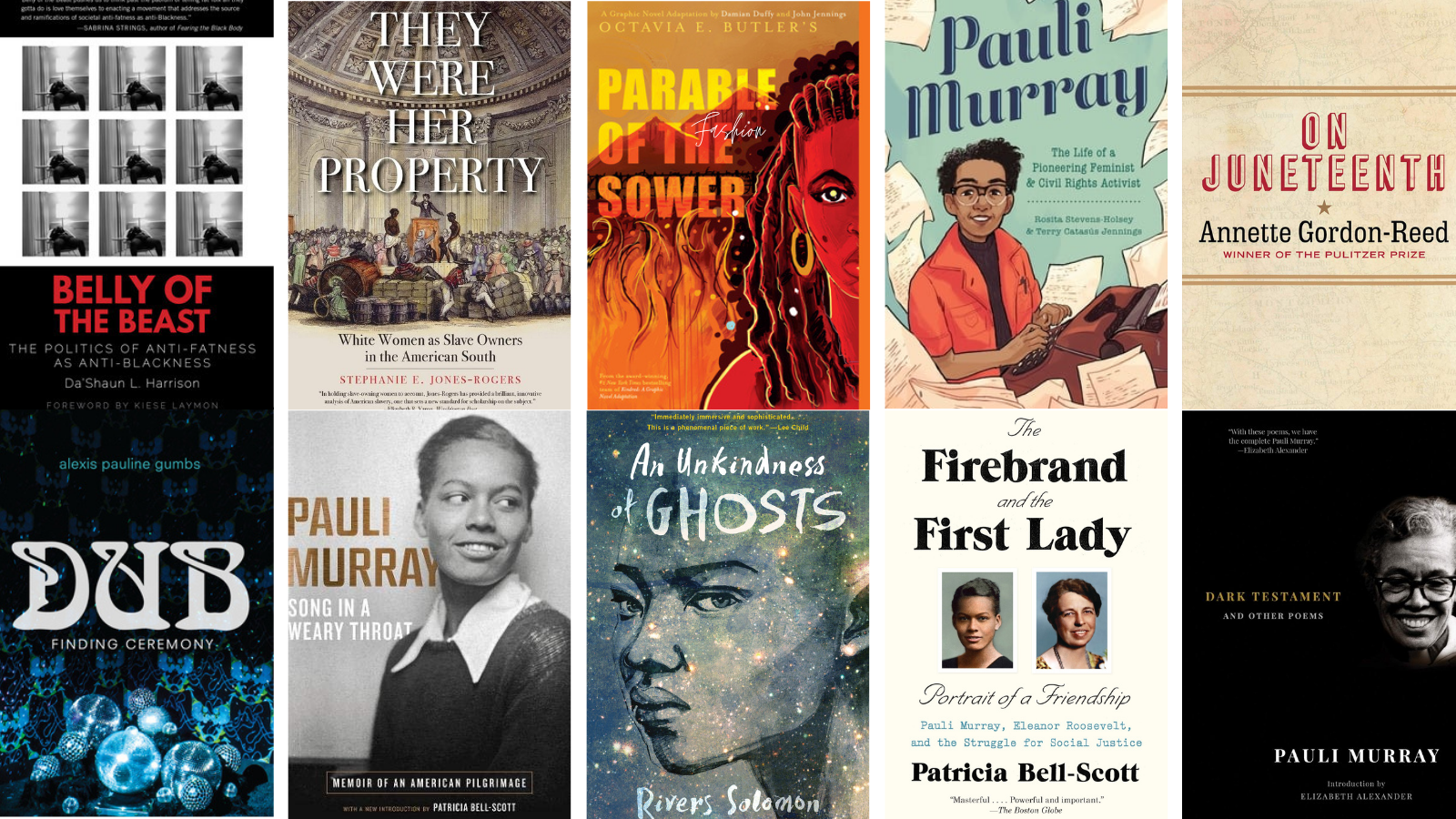
Pauli Murray Center's Book Gift Guide
Are you still looking for the right books to gift your loved ones this holiday season? Look no further! We picked out some of our favorite books and have provided links to purchase them from your local bookstore.
Are you still looking for the right books to gift your loved ones this holiday season? Look no further! We picked out some of our favorite books and have provided links to purchase them from your local bookstore. Through the links, you can either purchase physical copies or you can buy the audiobooks.
Books for the Kiddos & Niblings

Parable of the Sower by Octavia E. Butler
When global climate change and economic crises lead to social chaos in the early 2020s, California becomes full of dangers, from pervasive water shortage to masses of vagabonds who will do anything to live to see another day. Fifteen-year-old Lauren Olamina lives inside a gated community with her preacher father, family, and neighbors, sheltered from the surrounding anarchy.
There are mature themes in Parable of the Sower, so this is ideal for high school-age children.
Pauli Murray: The Life of a Pioneering Feminist and Civil Rights Activist by Rosita Stevens-Holsey and Terry Catasús Jennings
Rosita Stevens-Holsey is one of Pauli Murray’s nieces and a Pauli Murray Center board member. Her new book, co-authored with Terry Catasús Jennings, gives an overview of Pauli’s life, successes, and struggles.
This book is middle-grade and ideal for children between the ages of eight and twelve.
An Unkindness of Ghosts by Rivers Solomon
Aster lives in the lowdeck slums of the HSS Matilda, a space vessel organized much like the antebellum South. For generations, Matilda has ferried the last of humanity to a mythical Promised Land. On its way, the ship's leaders have imposed harsh moral restrictions and deep indignities on dark-skinned sharecroppers like Aster. Embroiled in a grudge with a brutal overseer, Aster learns there may be a way to improve her lot - if she's willing to sow the seeds of civil war.
An Unkindness of Ghosts contains mature themes and is ideal for high school-age children.
Books for the History-Lovers
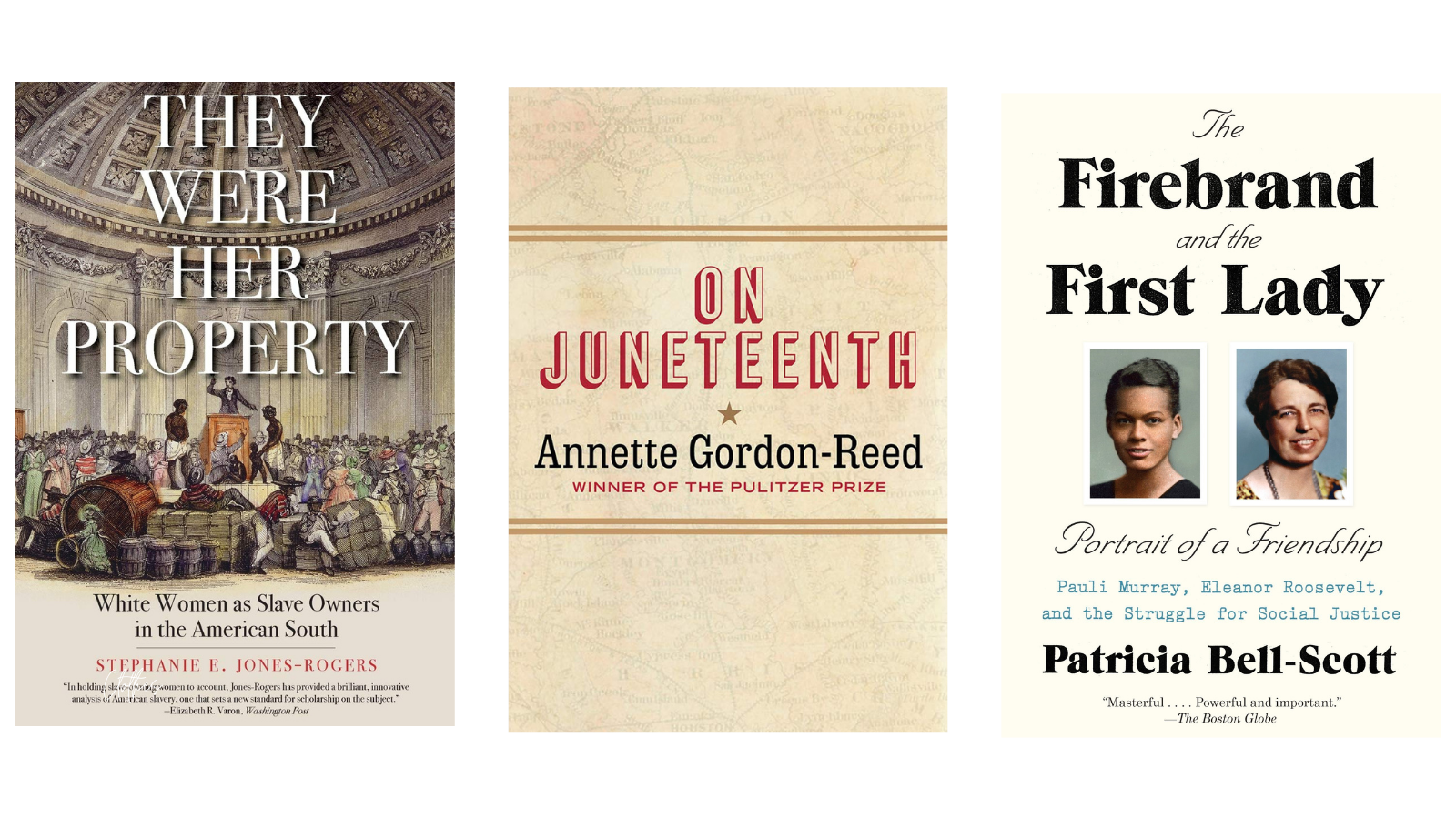
They Were Her Property: White Women as Slave Owners in the American South by Stephanie E. Jones-Rogers
Historian Stephanie E. Jones-Rogers draws on a variety of sources to show that slave-owning women were sophisticated economic actors who directly engaged in and benefited from the South’s slave market. White women actively participated in the slave market, profited from it, and used it for economic and social empowerment. By examining the economically entangled lives of enslaved people and slave-owning women, Jones-Rogers presents a narrative that forces us to rethink the economics and social conventions of slaveholding America.
This book will be discussed in the Pauli Murray Center’s online book club in March and April 2022!
On Juneteenth by Annette Gordon-Reed
In its concision, eloquence, and clear presentation of history, On Juneteenth vitally revises conventional renderings of Texas and national history. Especially now that the U.S. recognizes Juneteenth (June 19) as a national holiday, On Juneteenth is both an essential account and a stark reminder that the fight for equality is exigent and ongoing.
On Juneteenth will be discussed in our June 2022 online book club!
The Firebrand and the First Lady: Portrait of a Friendship: Pauli Murray, Eleanor Roosevelt, and the Struggle for Social Justice by Patricia Bell-Scott
Drawing on letters, journals, diaries, published and unpublished manuscripts, and interviews, Patricia Bell-Scott gives a close-up portrait of the friendship between Pauli Murray and Eleanor Roosevelt and how it was sustained over time, what each gave to the other, and how their friendship changed the cause of American social justice.
Books for Lovers of Poetry

Dark Testament & Other Poems by Pauli Murray
Originally published in 1970 and long unavailable, Dark Testament and Other Poems attests to Pauli Murray’s fierce lyrical powers. At turns song, prayer, and lamentation, Murray’s poems speak to the brutal history of slavery and Jim Crow and the dream of racial justice and equality.
We will discuss Dark Testament in our July 2022 book club!
Dub: Finding Ceremony by Alexis Pauline Gumbs
Alexis Pauline Gumbs's Dub: Finding Ceremony takes inspiration from theorist Sylvia Wynter, dub poetry, and ocean life to offer a catalog of possible methods for remembering, healing, listening, and living otherwise. In these prose poems, Gumbs channels the voices of her ancestors, including whales, coral, and oceanic bacteria, to tell stories of diaspora, indigeneity, migration, blackness, genius, mothering, grief, and harm. Tracing the origins of colonialism, genocide, and slavery as they converge in Black feminist practice, Gumbs explores the potential for the poetic and narrative undoing of the knowledge that underpins the concept of Western humanity. Throughout, she reminds us that dominant modes of being human and the oppression those modes create can be challenged, and that it is possible to make ourselves and our planet anew.
Miraculous! by Natalie Patterson
Natalie Patterson has the unique ability to bridge one’s personal experiences with the larger cultural occurrences using art, performance and custom workshops. Explore Natalie’s poetry in her collection “Miraculous!” below.
Books to Learn About Pauli Murray
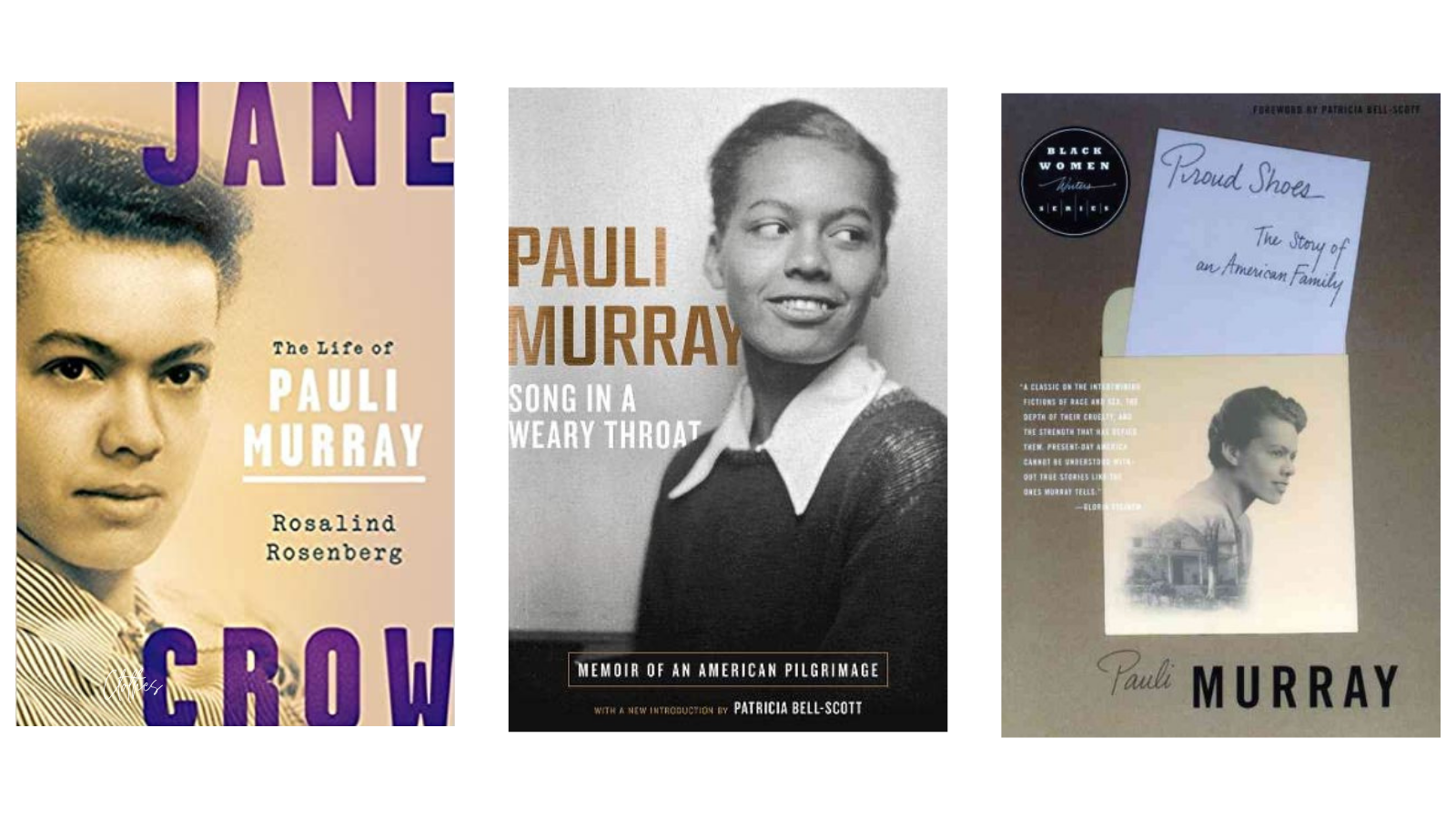
Jane Crow: The Life of Pauli Murray by Rosalind Rosenberg
Rosalind Rosenberg is Professor of History Emerita at Barnard College, Columbia University. In this definitive biography, Rosalind Rosenberg offers a poignant portrait of a figure who played pivotal roles in both the modern civil rights and women's movements.
Song in a Weary Throat: An American Pilgrimage by Pauli Murray
First published posthumously in 1987, Pauli Murray’s Song in a Weary Throat was critically lauded, winning the Robert F. Kennedy Book Award and the Lillian Smith Book Award among other distinctions. Yet Murray’s name and extraordinary influence receded from view in the intervening years; now they are once again entering the public discourse. With the republication of this “beautifully crafted” memoir, Song in a Weary Throat takes its rightful place among the great civil rights autobiographies of the twentieth century.
Proud Shoes: The Story of an American Family by Pauli Murray
First published in 1956, Proud Shoes is the remarkable true story of slavery, survival, and miscegenation in the South from the pre-Civil War era through the Reconstruction. Written by Pauli Murray the legendary civil rights activist and one of the founders of NOW, Proud Shoes chronicles the lives of Murray's maternal grandparents. From the birth of her grandmother, Cornelia Smith, daughter of an enslaved woman to the story of her grandfather Robert Fitzgerald, whose free Black father married a white woman in 1840, Proud Shoes offers a revealing glimpse of our nation's history.
New Releases from 2021

Belly of the Beast: The Politics of Anti-Fatness as Anti-Blackness by Da’Shaun Harrison
Belly of the Beast is a brief but powerful and informative book. Taking on desirability politics, f*ckability, healthism, hyper-sexualization, invisibility, and the connections between anti-fatness and police violence, Harrison viscerally and vividly illustrates the myriad harms of anti-fat anti-Blackness–and offers strategies for dismantling denial, unlearning the cultural programming that says “fat is bad,” and moving beyond the world we have now toward one that makes space for the fat and Black.
Belly of the Beast will be discussed in our January 2022 book club!
We Do This ‘Til We Free Us: Abolitionist Organizing and Transforming Justice by Mariame Kaba
In this timely collection of essays and interviews, Mariame Kaba reflects on the deep work of abolition and transformative political struggle. With chapters on seeking justice beyond the punishment system, transforming how we deal with harm and accountability, and finding hope in collective struggle for abolition, Kaba's work is deeply rooted in the relentless belief that we can fundamentally change the world.
From #BlackLivesMatter to Black Liberation (Expanded Second Edition) by Keeanga-Yamahtta Taylor, foreward by Angela Davis
In this stirring and insightful analysis, activist and scholar Keeanga-Yamahtta Taylor surveys the historical and contemporary ravages of racism and persistence of structural inequality such as mass incarceration and Black unemployment. In this context, she argues that this new struggle against police violence holds the potential to reignite a broader push for Black liberation.

Interview with Dr. Patricia Bell-Scott, Consulting Producer of "My Name Is Pauli Murray"
Barbara Lau, Executive Director, spoke with Dr. Patricia Bell-Scott, consulting producer of My Name Is Pauli Murray, author of The Firebrand and the First Lady: Portrait of a Friendship: Pauli Murray, Eleanor Roosevelt, and the Struggle for Social Justice, and professor emerita, Women’s Studies, Human Development & Family Science, of the University of Georgia.
Barbara Lau, Executive Director, recently spoke with Dr. Patricia Bell-Scott, consulting producer of My Name Is Pauli Murray, author of The Firebrand and the First Lady: Portrait of a Friendship: Pauli Murray, Eleanor Roosevelt, and the Struggle for Social Justice, and professor emerita, Women’s Studies, Human Development & Family Science, of the University of Georgia.
Barbara Lau: What was your role as a consulting producer for the film My Name is Pauli Murray?

Dr. Patricia Bell-Scott at a Duke Human Rights Center event (2016)
Dr. Patricia Bell-Scott: I saw my role in several ways. The first goal was to assist in identifying themes in Pauli Murray’s life. So, in the first conversations with co-directors Julie Cohen and Betsy West, and producer Talleah Bridges McMahon, we talked about the breadth of and themes in Murray’s life, as well as those issues that would resonate with viewers. Over time, our focus sharpened as the project developed.
My second goal was guided by a journal entry Pauli Murray wrote while struggling to conceptualize the family memoir that would one day become Proud Shoes. I keep this this quote close by. It reads: "Great art is not a matter of presenting one side or another, but of presenting a picture so full of the contradictions, tragedies, [and] insights of the period that the impact is at once disturbing and satisfying." I kept this idea in mind as we worked on the film. It encouraged me to do several things: to consider the complexity of this brilliant individual whose life covered most of the previous century, to examine the connections between Murray and the movements for human rights and human equality, and to spotlight the lasting impact of Murray’s work as a writer-thinker-activist.
In practical terms, this meant identifying documentary sources, potential interviewees, and sites for filming. I’d worked for 20 years on my biography, The Firebrand and the First Lady, and that prepared me for the role of consulting producer. I was familiar with the archival holdings, which include an array of documents, photographs, and recordings that proved to be helpful. I’d also interviewed and/or corresponded with many of Murray’s lifelong friends.
Because I knew how much poetry meant to Murray and I knew that it is in the poetry where one gets the deepest sense of Murray’s feelings, I used poetry liberally and strategically in The Firebrand and the First Lady. I am happy that viewers see and hear Murray reading poetry throughout the film. Although known primarily as a groundbreaking lawyer-activist, poet was the title Murray cherished most. My Name Is Pauli Murray chronicles public and private achievements and challenges. My hope is that we’ve honored Murray’s notion about the complexity of art.
Dr. Patricia Bell-Scott (center) filming at the Pauli Murray Center with local high school students for “My Name Is Pauli Murray” documentary (2020). Photo taken by Charles V. Underwood Jr.
In thinking about sites where we could film on location, Pauli Murray’s childhood home in Durham [now the Pauli Murray Center for History and Social Justice] was at the top of my list. As executive director of the Center, Barbara, I know that you know how strong Murray’s presence is at the house and on the grounds.
There are three moments in the film where viewers see the house—when I discuss the tragedy that brought Pauli Murray to Durham to live with relatives, in the clip of Charles Kuralt’s On the Road television series where Murray returns to preach in the church [Chapel of the Cross in Chapel Hill, NC] where her grandmother had been baptized, and near the end of the film where I’m standing in the yard with several high schoolers. This house, which symbolized Murray’s ancestral foundation, had a lasting impact.
The day we filmed someone said to me in the yard, “I wish Pauli could be here.” And I smiled and whispered, “Pauli is here.” At the time, I was thinking about Pauli’s response to Charles Kuralt who’d asked, "Wouldn't it be wonderful if your grandmother were here?" To which Murray said, “My grandmother was here right behind me." That’s what I felt the day we did the shoot at the house. Pauli was right there with us.
BL: Well, thank you so much Dr. Bell-Scott for recommending that the team come to Durham.
As you think about the people that may watch the film, what is it you hope they'll take away from that experience?

Poster for “My Name Is Pauli Murray”
PBS: My hope is that viewers will be inspired by Pauli Murray’s life and that they will come away from the film with a sense of how multidimensional Murray was. Murray could be brazen, courageous, and daring, and also vulnerable, sensitive, and shy. Murray was woman-loving, kept medical records documenting gender-identity conflict, presented as female most of her life, and preached that gender—like race—was a social construct.
Pauli Murray’s great-niece Karen R. Ross shares how her aunt, who’d been a talker and doer in Karen’s youth, became a listener and servant after becoming a priest. The reflections of friends, family, colleagues, former students, scholars, and a new generation of activists reflect the diversity of perspectives on Murray.
Murray’s friend, the Reverend Dovey Johnson Roundtree who was also an attorney, told me that Pauli aimed to live an authentic life, and I hope viewers get a sense of that from the personal declaration at the beginning of the film. That video footage of Murray, recorded by a student, had not been digitized or seen before director Julie Cohen discovered it.
“My hope is that viewers will be inspired by Pauli Murray’s life and that they will come away from the film with a sense of how multidimensional Murray was. Murray could be brazen, courageous, and daring, and also vulnerable, sensitive, and shy. ”
I also hope that the film is a response to young people who have said to me, “I’m upset. How did I get through American history or law school without any professor mentioning Pauli Murray? And where can I learn more?” I think about the Black Lives Matter, feminist, LGBTQ+, and religious activists, who’ve asked, “What would have been Pauli’s reaction to the contemporary social justice movement?” “Did she get tired, and how did she combine activism with the rest of life? “ I think of the writers yet-to-be published, who’ve asked, “What kept Murray going in the face of a literary market and readers who didn’t undertand Proud Shoes for decades?”
There aren’t specific answers to these questions, but I hope that some explanations are evident. Yes, Murray was emotionally and physically exhausted many times, yet flowered with the support and acceptance of family, friends, and loved ones. Karen spoke of the acceptance Murray got from Aunt Pauline, who referred to Pauli as her “boy-girl.” Former students and biographer Rosalind Rosenberg talk about the significance of Murray’s intimate partnership with Irene Barlow. I talk about how the relationship with Eleanor Roosevelt moved from confrontation, to allyship, to a friendship with mother-daughter undercurrents.
My hope is that the film will encourage viewers to be mindful of those social activists in our midst who need support. There are firebrands, as you've said Barbara, who need the support that Pauli Murray didn't get. That support can be a simple as a call or note, to be present in a moment of crisis, to credit someone for their pathbreaking work (as Justice Ruth Bader Ginsburg by citing Pauli Murray work as a legal theorist), to provide respite, material or financial assistance when we can.
I've gotten some heart-warming messages from young people. I'm thinking of a writer who props Pauli Murray’s memoir in her writing chair at the close of the day. To have it there waiting at attention the next morning inspires her, she says, “to write her truth.” My hope is that My Name is Pauli Murray will inspire viewers to seek truth and social justice.
BL: Thank you so much, Dr. Bell-Scott.